

Apple has officially launched the iPhone 18 Pro and iPhone 18 Pro Max, marking the company’s first major product reveal under new CEO John Ternus, who took over from Tim Cook earlier this year. This year’s Pro lineup skips a standard iPhone 18 entirely – that model is expected only in spring 2027 – which means the spotlight this September belongs fully to the Pro series and Apple’s first foldable device, the iPhone Duo.
The iPhone 18 Pro is not a minor refresh. It introduces Apple’s first 2-nanometer chip, a redesigned camera system with variable aperture, under-display Face ID, and a completely reworked cooling architecture. Here’s everything worth knowing before you decide whether to upgrade.
Design and Build
The iPhone 18 Pro keeps the familiar Pro form factor but refines it in several ways. It measures 150.0 mm in height, 71.9 mm in width, and 8.75 mm in depth, weighing 211 grams. The larger iPhone 18 Pro Max comes in at 163.4 mm tall, 78.0 mm wide, with the same 8.75 mm depth, weighing 249 grams.
Both phones use an aluminium unibody design, paired with Ceramic Shield 2 on the front and a Ceramic Shield back panel — a durability upgrade over previous generations. The phones are IP68 rated for dust and water resistance, tested to a depth of 6 metres for up to 30 minutes.
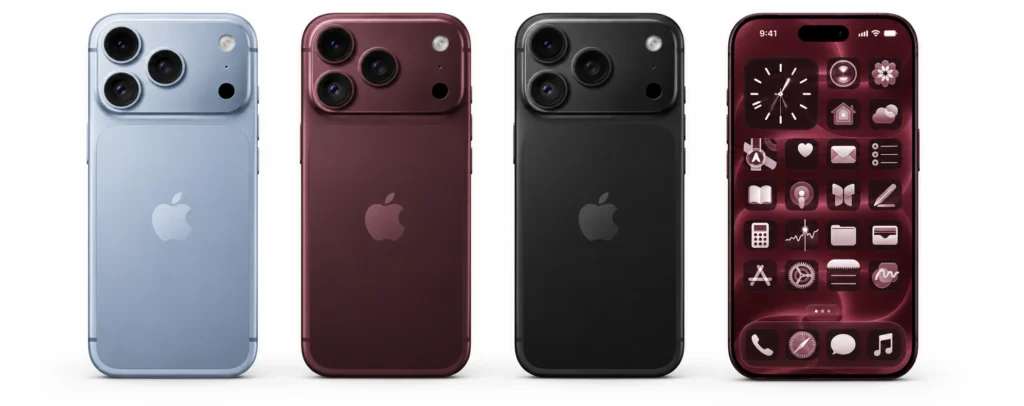
Colour options this year include Black, Silver, Glacier, and a new Burgundy finish, giving buyers a genuinely fresh palette compared to last year’s lineup.
Display
The iPhone 18 Pro uses a 6.3-inch Super Retina XDR OLED display with a resolution of 2622×1206 pixels at 460 ppi, while the Pro Max steps up to a 6.9-inch panel at 2868×1320 pixels, also at 460 ppi. Both models retain ProMotion adaptive refresh rates up to 120Hz, Always-On display, HDR support, True Tone, and wide colour (P3) reproduction.
More Read
Brightness has been pushed further too – typical brightness sits at 1,000 nits, with peak HDR brightness of 1,600 nits and outdoor peak brightness reaching 3,000 nits, making the screen easier to read in direct sunlight. The Dynamic Island returns, now smaller than before, and both displays carry fingerprint-resistant and anti-reflective coatings.
A20 Pro Chip – Apple’s First 2nm Processor
The headline upgrade is the A20 Pro chip, Apple’s first processor built on a 2-nanometer process. It pairs a 6-core CPU (2 performance cores and 4 efficiency cores) with a 7-core GPU that includes Neural Accelerators for on-device machine learning tasks. A dual 16-core Neural Engine handles AI workloads, and the chip supports hardware-accelerated ray tracing for more realistic gaming and graphics rendering.
To keep this power sustained under load, Apple redesigned the internal cooling system with a vapour chamber attached directly to the chip, significantly increasing the cooling surface area compared to previous models. In practical terms, this should mean less thermal throttling during extended gaming sessions, 4K video recording, or heavy multitasking.
Also read : Best Tablets for Students in India 2026: Top Picks.
Camera System: The Biggest Change This Generation
Camera hardware is where the iPhone 18 Pro genuinely breaks from its predecessors. The rear setup is a 48MP Pro Fusion camera system consisting of three lenses:
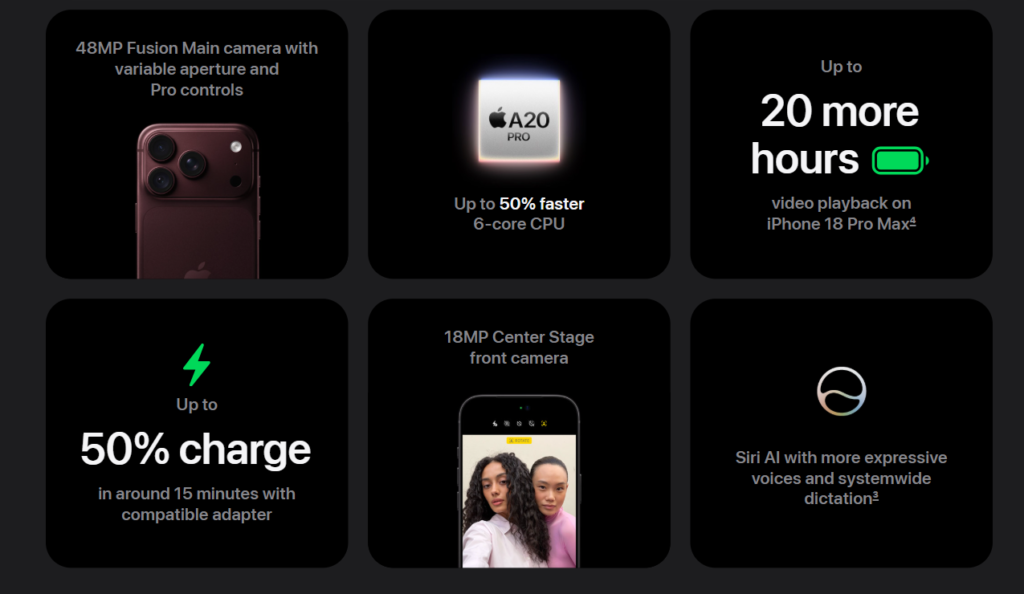
- 48MP Fusion Main camera with a variable aperture (ƒ/1.48, ƒ/1.8, ƒ/2.8, ƒ/4.0) – a first for any iPhone – at a 24mm focal length, with second-generation sensor-shift optical image stabilisation and 100% Focus Pixels. It also enables a 12MP optical-quality 2x telephoto shot at 48mm.
- 48MP Fusion Ultra Wide at 13mm, ƒ/2.2 aperture, with a 120° field of view and Hybrid Focus Pixels.
- 48MP Fusion Telephoto at 100mm (4x optical zoom), ƒ/2.8 aperture, using a tetraprism design with 3D sensor-shift optical image stabilisation. It also enables a 12MP optical-quality 8x telephoto shot at 200mm.
Combined, this gives users an 8x optical-quality zoom in, 2x optical zoom out, a 16x optical-quality zoom range, and digital zoom up to 40x. Photographers also get manual pro controls for aperture, shutter speed, white balance, and histogram viewing – features that previously required third-party apps.
A new Apple Reference Image feature (on the Fusion Main camera) embeds signed sensor data into photos, allowing users to later verify whether an image has been edited from its original capture. Other imaging tools carry over and improve, including Photonic Engine, Deep Fusion, Smart HDR 5, Night mode, Photographic Styles, and ProRAW support in HEIF, JPEG, and DNG formats.
Also read : Redmi K100 Series Spotted on Geekbench: Powered by Snapdragon 8 Elite Gen 5 and a Massive Battery.
On video, the iPhone 18 Pro can record 4K Dolby Vision at up to 120fps on the main camera, along with Cinematic mode up to 4K at 60fps, Action mode up to 2.8K at 60fps, and ProRes RAW capture with external recording support. Apple Log 2 and Academy Color Encoding System support round out the professional video toolkit, alongside Genlock support for synchronized multi-camera shoots.
The front camera has also been upgraded to an 18MP Center Stage camera with an ƒ/1.9 aperture, autofocus via Focus Pixels, and support for 4K Dolby Vision recording at up to 60fps.
Battery Life and Charging
Battery performance sees a solid jump this year. The iPhone 18 Pro offers up to 23 hours of typical use, up to 34 hours of video playback, and up to 31 hours of streamed video playback. The iPhone 18 Pro Max extends this further, with up to 29 hours of typical use, up to 43 hours of video playback, and up to 38 hours of streamed playback.
Fast charging has improved too – the iPhone 18 Pro can reach 50% charge in around 15 minutes using a 60W-capable adapter with Adjustable Voltage Supply over USB-C, or in 30 minutes using a 35W adapter with a MagSafe Charger. MagSafe and Qi2 wireless charging both support speeds up to 25W.
Also read : iQOO 15 Ultra Global Launch Near ? EEC Certification Hints at International Release.
Connectivity and Chips
Beyond the A20 Pro, Apple has introduced its second-generation in-house modem, the Apple C2 cellular modem, supporting 5G (sub-6 GHz) with 4×4 MIMO and Gigabit LTE. Wireless connectivity comes via the new Apple N1 wireless networking chip, bringing Wi-Fi 7 (802.11be), Bluetooth 6, and Thread networking support. The phone also includes Apple’s second-generation Ultra Wideband chip and NFC with reader mode for contactless payments and Express Cards.
Location accuracy benefits from precision dual-frequency GPS covering GPS, GLONASS, Galileo, QZSS, BeiDou, and India’s NavIC system – a useful detail for users in India relying on regional satellite positioning.
Software: iOS 27 and Apple Intelligence
The iPhone 18 Pro ships with iOS 27, built around the next generation of Apple Intelligence and a redesigned Siri AI experience. Siri is now positioned as more conversational and capable of pulling context from across apps to complete tasks – for example, searching old emails or acting on whatever is currently on screen. Apple has emphasized that this version of Siri is built with privacy as a core requirement, alongside the platform’s existing end-to-end encryption for iMessage and FaceTime.
It’s worth noting that some Apple Intelligence features, including elements of Siri AI, are rolling out on a staggered regional basis, with certain markets seeing later availability. Buyers should check regional feature support before assuming full functionality on day one.
Storage, Buttons and Design Details
Both the iPhone 18 Pro and Pro Max are available in 256GB, 512GB, 1TB, and 2TB storage configurations, giving users flexibility depending on how much they shoot in ProRes or store locally.
On the hardware side, the phones retain the Action Button and Camera Control button introduced in earlier generations, alongside the volume controls and side button. The Action Button can be customized for Silent Mode, Focus, Camera, Visual Intelligence, Flashlight, Voice Memo, Translate, Magnifier, and more, while the Camera Control button offers quick access to exposure, depth, zoom, camera switching, styles, and tone adjustments.
iPhone 18 Pro vs iPhone 17 Pro: What Actually Changed
| Feature | iPhone 18 Pro | iPhone 17 Pro |
|---|---|---|
| Chip | A20 Pro (2nm) | A19 Pro |
| Main Camera | 48MP with variable aperture | 48MP fixed aperture |
| Modem | Apple C2 | Previous-gen modem |
| Wireless Chip | Apple N1 (Wi-Fi 7) | Earlier Wi-Fi standard |
| Face ID | Under-display | Notch/pill cutout |
| Cooling | Vapour chamber attached to chip | Standard thermal design |
| Battery (typical use) | Up to 23 hours | Lower baseline |
The variable aperture camera and the shift to a 2nm chip are the two most meaningful upgrades. If you’re using an iPhone 15 Pro or older, this is a substantial jump. If you already own an iPhone 17 Pro, the improvements are real but incremental – worth considering mainly if photography and sustained performance under heavy use matter most to you.
The iPhone 18 Pro is less about flashy redesigns and more about deep, practical engineering upgrades – a genuinely new camera hardware system, Apple’s first 2nm chip, a smarter cooling architecture, and meaningfully longer battery life. For photography enthusiasts and anyone who pushes their phone hard with video work or gaming, this generation delivers real, usable improvements rather than marketing-only changes.
Frequently Asked Questions (FAQ)
1. What chip does the iPhone 18 Pro use ?
The iPhone 18 Pro is powered by Apple’s A20 Pro chip, the company’s first processor built on a 2-nanometer process, featuring a 6-core CPU and 7-core GPU.
2. Does the iPhone 18 Pro have a variable aperture camera ?
Yes, the 48MP Fusion Main camera includes a variable aperture (ƒ/1.48 to ƒ/4.0) – the first time this has appeared on an iPhone.
3. What is the battery life of the iPhone 18 Pro ?
The iPhone 18 Pro offers up to 23 hours of typical use and up to 34 hours of video playback, while the iPhone 18 Pro Max extends to 29 hours typical use and 43 hours of video playback.
4. Is the iPhone 18 Pro water resistant ?
Yes, it carries an IP68 rating, tested to withstand depths of up to 6 metres for 30 minutes.
5. What storage options are available for the iPhone 18 Pro ?
The phone is available in 256GB, 512GB, 1TB, and 2TB storage configurations.